Your Product Moat is a Myth
A first-principles guide to competitive advantage when AI has commoditized everything. Hint: It's not your features, your model, or your UI.
I'm going to say something that might be hard to hear. For the last decade, we, as product managers, have been worshipping a false god: the feature moat. We told ourselves that a 10x better feature, a slicker UI, or a more integrated workflow would protect us. We were wrong.
Let's be honest. In 2026, your feature isn't a moat. It's a speed bump. A competitor with a decent AI agent can replicate it in a weekend [1]. Your beautiful UI? It's a skin that can be generated in minutes. And your exclusive access to GPT-5 or Claude 4? That's just a line in a config file, available to anyone with a credit card.
The brutal truth is this: the traditional SaaS playbook is evolving faster than most of us realize. AI has liquefied the very foundations of product differentiation. When the cost of building software drops to near zero, value has to go somewhere else. The question is, where?
I see most PMs looking in the wrong places. They're stuck on a feature treadmill, racing to build things that just don't matter anymore. I've been there myself. I've shipped features I was proud of, only to watch a competitor replicate them in a sprint. I've invested in UI polish that was obsolete before the next design system dropped. I've made the mistake of thinking that being first with a capability was the same as owning a market. It isn't.
This post is my attempt to map out where the real, durable moats are being built in 2026. It's a first-principles guide for anyone trying to build a lasting business in an age of total commoditization. If you're still counting on your features to save you, consider this your final warning.
Part 1: The Great Moat Collapse
The value of software used to be tied to how hard it was to create. That difficulty is gone. What's left is a catastrophic collapse of the moats we thought we had. The Model Commoditization Curve I've drawn up shows this clearly. The value captured by the model providers themselves? That peaked back in 2023-2024. This is a direct consequence of the non-linear trends I explored in The Age of Amplification — capability is accelerating while the value shifts to the application layer. We're now past the "Commoditization Threshold." Model capability is becoming a utility, like electricity, and the real value is rapidly shifting to the layers you build on top.
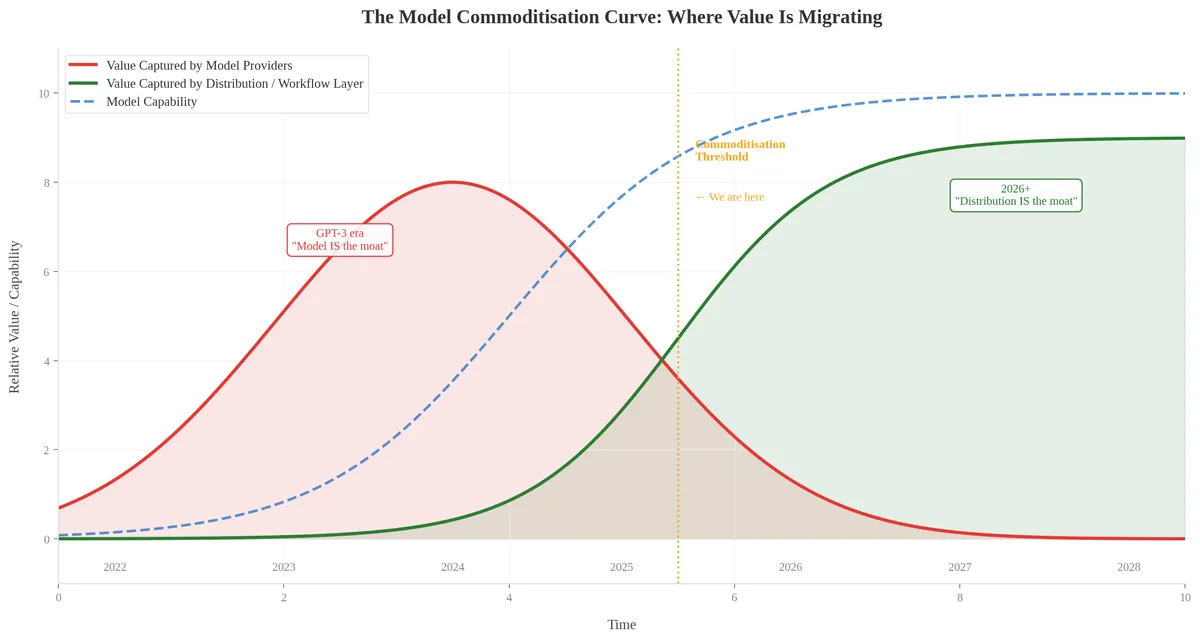
This isn't theory; it's happening right now. What I once thought was a defensible feature is now a fragile illusion. Let me be specific about what has collapsed:
AI Features: I've seen teams use agentic coding frameworks to replicate core AI features in days, not months [1]. As I detailed in my Agentic AI Product Playbook, the real work isn't building the feature, it's architecting the system that thinks. Your summarization tool isn't special. Your AI search isn't special. Your "smart recommendations" aren't special. These are table stakes, not moats.
UI/UX Design: I can prompt a tool like v0.dev to generate a high-fidelity UI in minutes. That polished interface I spent weeks on is no longer a strong defense. The design systems that took years to build are now being generated on demand. The visual differentiation that used to take a team of designers is now a prompt away.
Model Access: My access to a frontier model is a fleeting advantage. Open-source models like Llama and Mistral are closing the capability gap at a remarkable pace. The best proprietary models are a credit card swipe away. The idea that you have a "better AI" than your competitor is almost certainly temporary.
Speed of Execution: Even team velocity, which I used to consider a genuine moat, is being compressed. A small, AI-native team can now ship what used to take a large engineering organization. The advantage of being fast is diminishing as everyone gets faster.
Trying to defend a business on these grounds is like building a fortress on quicksand. The faster you build, the faster you sink. I've learned that the winners of the next decade won't be the ones who build the most features. They'll be the ones who build the most durable, non-replicable assets around their product while everyone else is stuck on the treadmill.
Part 2: The New Moat Stack: From Commodity to Fortress
So, if the old moats are crumbling, what's next? The answer, I believe, is in a new hierarchy of defensibility. We have to stop seeing our products as a list of features and start seeing them as a stack of compounding advantages. I've learned that the most durable products are built from the bottom up, but they are defended from the top down.
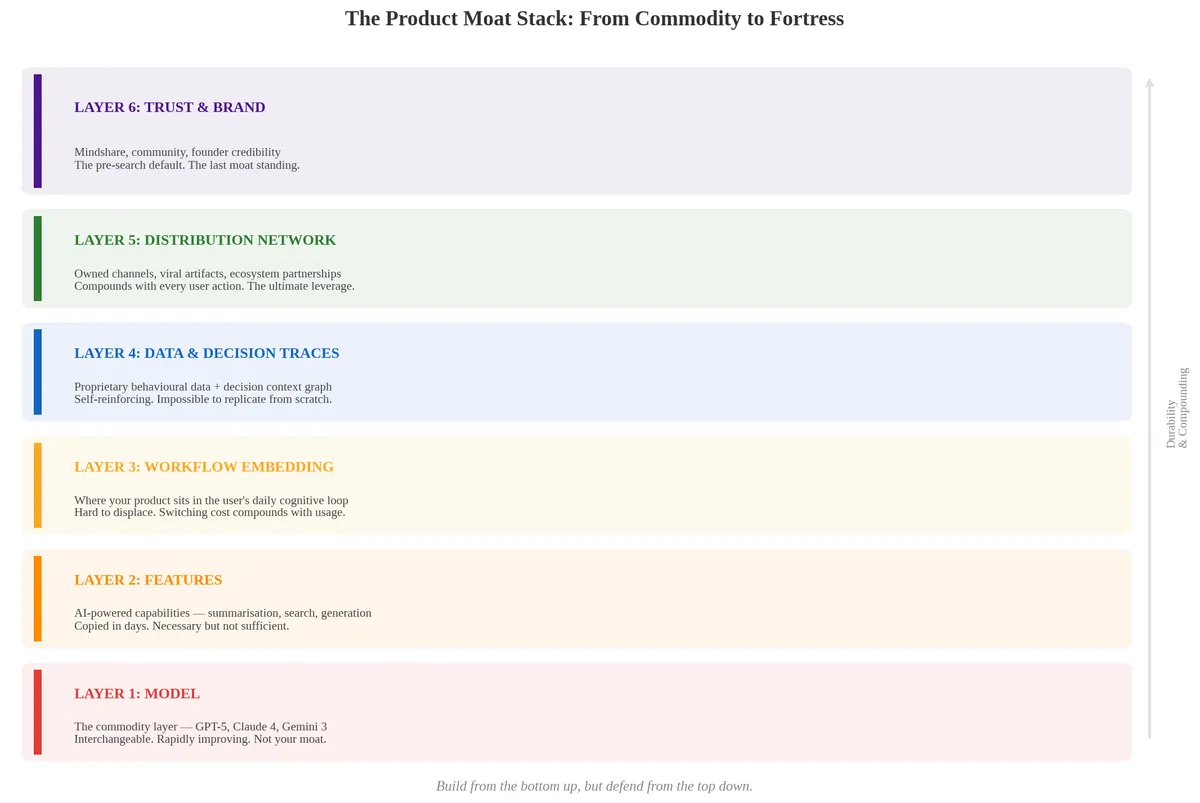
I call this the Product Moat Stack. It's how I re-frame my thinking from features to layers of compounding value. Each layer is more durable than the one below it, and each layer creates the conditions for the next one to form.
Layer 1: Model (Commodity). This is your foundation. It's essential, but it gives you zero defensibility. Your choice of LLM is a tactical call, not a strategic one. The question isn't "which model do we use?" but "what do we build on top of the model that no one else can replicate?" I've seen too many teams spend months debating GPT-4 vs. Claude 3 when they should be building the layers above.
Layer 2: Features (Fragile). This is what your user sees and interacts with. You need it, but it's the easiest part for competitors to copy. Features are necessary for acquisition — they're the reason someone tries your product. But they are not the reason someone stays. I've learned to think of features as the front door, not the foundation.
Layer 3: Workflow Embedding (Temporary). This is where your product becomes part of a user's daily cognitive loop. When you're the default tool for a specific, frequent task, you create stickiness. Switching costs start to build here. The user has to re-learn a new tool, migrate their data, and rebuild their habits. This is real friction. But I've seen 10x better workflows displace incumbents. It's durable, but it's not a fortress. A sufficiently motivated competitor with a sufficiently better product can still displace you.
Layer 4: Data & Decision Traces (Structural). This is the first truly durable layer I've found. It's not just about having your own data. It's about capturing the context of how that data is used to make decisions. Ashu Garg of Foundation Capital calls these "decision traces," and I agree they are a compounding asset that's impossible for an outsider to replicate [2]. Every time a user touches your product, they should be making it smarter for everyone else. I'll go deeper on this in Part 5.
Layer 5: Distribution Network (Fortress). This is where you own the path to your users. I'm not just talking about marketing channels. I mean viral artifacts (outputs users share), ecosystem partnerships, and product-led growth loops. When your product sells itself, you have an almost insurmountable advantage. It's the core unfair advantage I wrote about in my guide on moving from PM to Venture Builder, where leveraging existing distribution is the single biggest factor in de-risking a new venture.
Layer 6: Trust & Brand (The Last Moat). This is your ultimate fortress. It's the name that pops into your user's head before they even search. It's built on founder credibility, community, and consistently delivering on your promise. It's the slowest moat to build and the hardest to destroy. In an age of AI-generated content and AI-generated products, authentic trust is the scarcest resource of all.
Part 3: The Durability Matrix: A Tactical Framework for PMs
Understanding the stack is one thing. Acting on it is another. I created the Moat Durability Matrix as a tactical tool to help my teams prioritize. It maps different moats based on two dimensions: how easy they are to replicate by a well-funded competitor, and how fast they compound over time. The intersection of these two dimensions tells you where to invest.
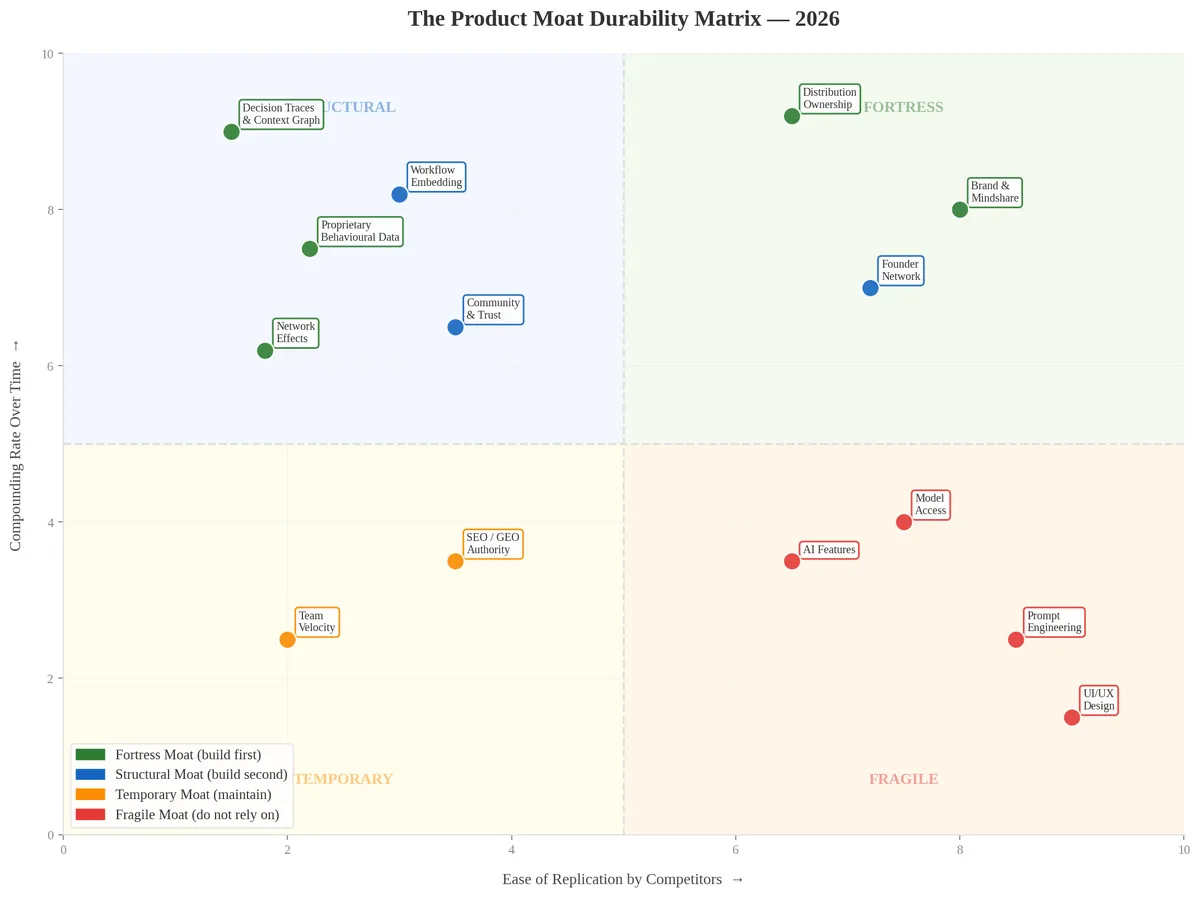
This matrix gives me a clear mandate for my product strategy. Let me walk through each quadrant with the honesty I wish someone had given me earlier in my career.
Fragile Moats (High Replication, Low Compounding). I tell my teams not to invest their primary energy here. AI features, prompt engineering, and UI polish are table stakes, not defensible ground. Relying on them is a recipe for a feature treadmill. You'll be constantly shipping to stay relevant, and you'll never get ahead. The tragedy is that most roadmaps are dominated by work in this quadrant. It feels productive. It generates demos. It gets press. But it doesn't build a business.
Temporary Moats (Low Replication, Low Compounding). These are worth maintaining, but they aren't your core fortress. Team velocity and SEO/GEO authority can give you a head start. They are genuinely hard to replicate quickly. But a well-funded competitor with a better strategy can close the gap over time. Think of these as the moats that buy you time to build the real ones.
Structural Moats (Low Replication, High Compounding). This is where I see real defensibility begin. Embedding a product deep into a user's workflow and building a proprietary data asset from their decision traces creates a powerful, self-reinforcing loop. The deeper you embed, the more data you collect. The more data you collect, the better your product gets. The better your product gets, the deeper you embed. This is a virtuous cycle that a competitor starting from scratch simply cannot replicate.
Fortress Moats (High Replication, High Compounding). This is my endgame. Owning distribution channels and building an iconic brand creates a dominant market position. These moats are hard to copy not because they're technically complex, but because they require time, consistency, and trust. You can't buy a brand. You can't acquire a community. You have to earn them, one interaction at a time.
The strategic imperative for me is clear: starve the fragile and feed the fortress. I evaluate every product decision against this matrix. Are we building a feature that will be copied in a month, or are we investing in a system that will compound for years?
Part 4: The Distribution Flywheel: The Last Fortress Standing
Of all the fortress moats, the one I find most powerful and least understood is distribution. In the AI era, distribution isn't a marketing function; it's a product design principle. The most successful products I've seen are not just used; they are transmitted. They spread through the act of being used.
I call this the Distribution Flywheel. It's a virtuous cycle where each part of the product's usage actively drives the next. Most products are designed to be consumed. The best products are designed to be shared.
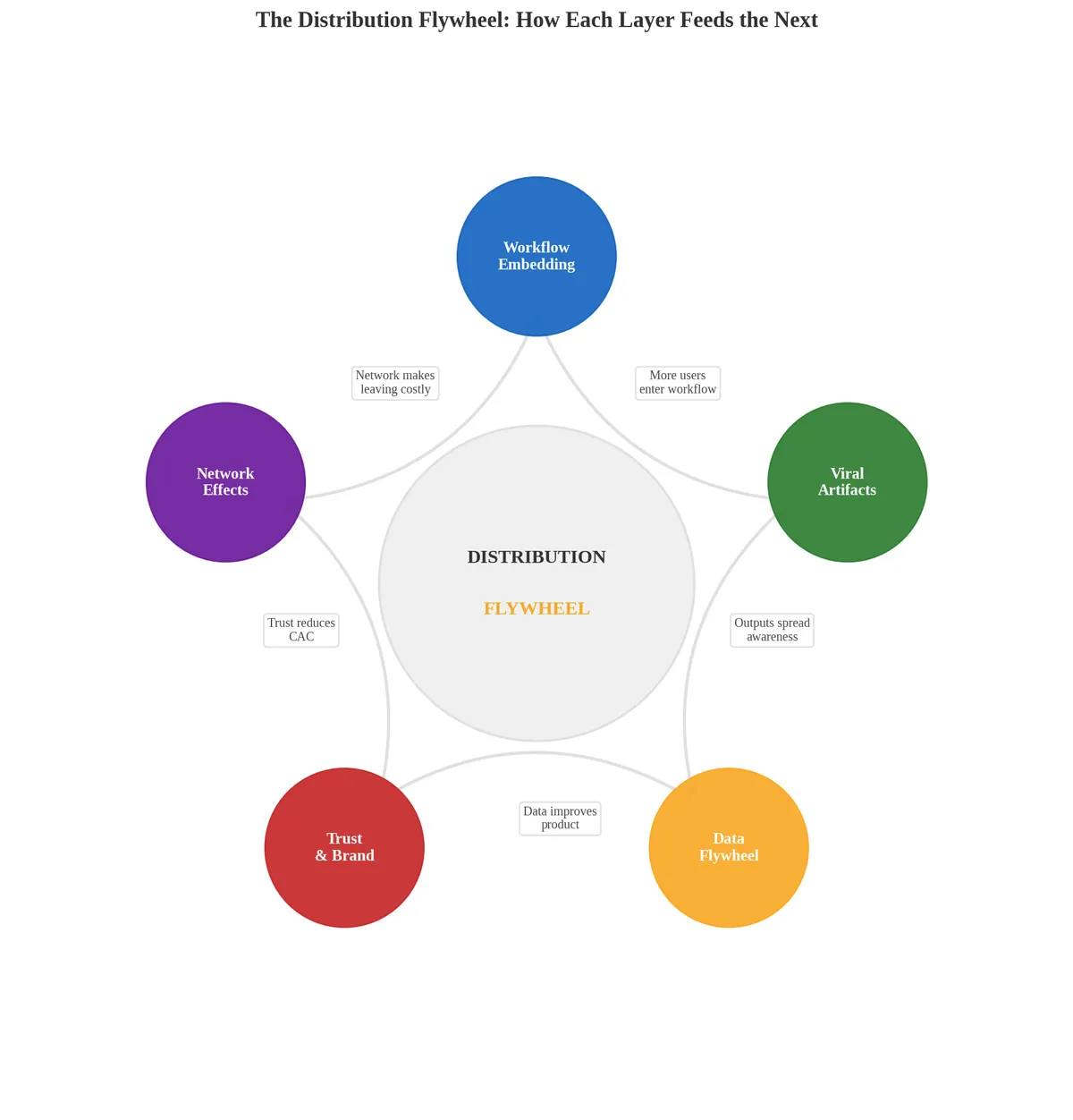
Workflow Embedding is the entry point. Your product becomes essential for a core task, driving daily use. This is the prerequisite for everything else. If users don't come back every day, the flywheel never starts.
Viral Artifacts are the engine. The outputs of your product are inherently shareable. Think of a Perplexity answer, a Gamma presentation, or a Midjourney image. Every time a user does their job, they are marketing your product for you. This is the most underrated growth mechanic in product design. I ask every team I work with: "What does your product produce that a user would want to share?" If the answer is nothing, the flywheel is broken.
The Data Flywheel is the intelligence layer. The shared artifacts and increased usage generate more data. I use this data to improve the core product, making it even more valuable and sticky. This is where distribution and data moats converge. Every share is a data point. Every view is a signal. Every click is a training example.
Trust & Brand is the compounding effect. As more people see and use the high-quality outputs, your brand becomes synonymous with the category. This, in turn, reduces your customer acquisition costs. The best brands don't need to advertise. They need to be used.
Network Effects are the lock-in. As your community grows, the product's value increases for each user. Think shared templates, community support, and integrations. This makes it harder for users to leave, not because you've trapped them, but because leaving means losing access to a valuable network.
This flywheel is the engine of compounding growth. It's why Perplexity didn't need to out-model Google; they just created a better, more shareable answer format [3]. It's why I see Gamma as a threat to PowerPoint; its decks are designed to be viewed and shared online, creating a viral loop that Microsoft's file-based world lacks. It's why Figma became the dominant design tool not by having better features than Sketch, but by making collaboration the default mode of working.
Part 5: The Data Moat in Depth: Decision Traces and the Context Graph
I want to spend more time on the data moat, because I think it's the most misunderstood and most underinvested layer in most AI products today. Most teams think about data in terms of volume. They want more data. They want bigger datasets. They want to fine-tune their models on proprietary data. This is the right instinct, but it's the wrong frame.
The real data moat isn't about volume. It's about context.
Here's what I mean. Imagine two products that both help a sales team write outreach emails. Product A logs the emails that get sent. Product B logs the emails that get sent, the alternatives that were considered, the time the user spent on each option, the edits they made before sending, and the response rate of each email. Product A has data. Product B has decision traces.
The difference is enormous. Product A can tell you what happened. Product B can tell you why it happened. Product B can build a model of how this specific sales team thinks, what language resonates with their specific prospects, and what patterns predict success. That model is impossible for a competitor to replicate, because the competitor doesn't have access to the context that created it.
I call the accumulation of these decision traces a Context Graph. It's a proprietary map of how your users think, decide, and act within your product. Foundation Capital's Ashu Garg identified this as one of the most important emerging moats in AI [2], and I've seen it play out in practice. The companies that are building context graphs today are building the most defensible AI products I've seen.
Here's how to start building one. First, identify the single most important decision a user makes in your product. For a writing tool, it might be which suggestion to accept. For a CRM, it might be which lead to prioritize. For a design tool, it might be which layout to choose. Second, instrument your analytics to capture not just the final choice, but the full context. What options did they see? What did they hover over? How long did they deliberate? What did they change after the fact? Third, build a simple feedback loop that uses this data to improve the next recommendation. That's the first turn of your context graph flywheel.
The companies that understand this are already building an insurmountable lead. The companies that are still thinking about data in terms of volume are going to be very surprised in 2027.
Part 6: Case Study: Feature-First vs. Moat-First
Let's make this concrete with a thought experiment. Imagine two companies in 2026, both trying to build the dominant AI writing tool for marketing teams.
Company A: "Feature-First"
Company A's strategy is to build the most powerful AI features faster than anyone else. Their Q1 roadmap is a new "AI-powered tone analyzer." Q2 is a "brand voice generator." Q3 is a "multi-channel content repurposing" tool. Their moat is technical velocity and feature superiority. They raise a Series A on the strength of their demo.
Company B: "Moat-First"
Company B's strategy is to build a compounding system of moats around a simple, elegant core workflow. Their Q1 roadmap is focused on building a public, shareable link for every piece of content created — with a "Made with [Product B]" watermark that links back to the product. Q2 is about creating a community template library where users can share and remix each other's best-performing content. Q3 is about instrumenting the platform to understand which content patterns drive the highest engagement for each industry vertical, creating a proprietary "content performance graph."
How This Plays Out
For the first six months, Company A looks like the winner. They get press coverage for their flashy features. Their demo is impressive. They win some early customers on the strength of their AI capabilities. Company B's product looks simpler, even boring, by comparison.
But by the end of the year, the picture changes. Company A's growth stalls. Competitors have copied their tone analyzer and brand voice generator. They're stuck on the treadmill, constantly having to ship the next new feature to stay relevant. Their CAC is rising because they have no organic distribution. Their churn is high because there's always a slightly better feature somewhere else.
Company B, on the other hand, has slower initial growth. But every piece of content shared with a watermark is now a free advertisement. Every template contributed to the community is making the platform more valuable for everyone else. And every click is feeding their content performance graph, allowing them to build a truly intelligent system that can predict what content will work for a specific audience in a way that no competitor can copy.
By 2027, Company A is irrelevant. Company B is the category standard. They didn't win by building better features. They won by building better moats.
This thought experiment isn't hypothetical. It's the story of Canva vs. every other design tool that launched in the 2010s. It's the story of Notion vs. every other note-taking app. It's the story of Figma vs. Sketch. In every case, the winner wasn't the one with the best features at launch. It was the one that built the most powerful compounding system around their product.
Part 7: Playbook: How to Build a Real Moat This Quarter
This isn't just theory. You can start building these moats today. Here is the tactical playbook I use with my teams.
Step 1: Conduct a Moat Audit.
I use the Moat Durability Matrix as a scorecard. Map out every feature and initiative your team is working on. Be brutally honest. How much of your roadmap is in the "Fragile" quadrant? I push my teams to have at least 50% of their effort focused on the "Structural" and "Fortress" quadrants by the end of the next quarter. Here is a simple template you can use:
| Feature/Initiative | Moat Layer | Durability Quadrant | Justification |
|---|---|---|---|
| New AI Summarizer | Features | Fragile | Can be replicated in days with any frontier model |
| Slack Integration | Workflow | Temporary | High switching cost, but a better integration could displace it |
| User Action Logging | Data | Structural | Captures unique behavioral context |
| Community Template Library | Distribution | Fortress | Network effect compounds with every contribution |
The goal of this audit isn't to kill all feature work. Features are still necessary. The goal is to be honest about what you're building and why. If you're building a feature, you should know it's fragile and have a plan for the structural moat that will outlast it.
Step 2: Design a Viral Artifact.
Look at your product's output. Is it a dead end, or is it a seed? I challenge my teams to brainstorm one change to make their output 10x more shareable. Could you add a watermark? A one-click "share to X" button with a pre-populated summary? A public link with a rich, interactive view? A "made with" badge that links back to your product? The best viral artifacts are ones that are genuinely useful to share — not just promotional. A Perplexity answer is shared because it's a good answer, not because it has a Perplexity logo on it.
Step 3: Instrument a Decision Trace.
I ask my teams to identify the single most important decision a user makes in their product. Then, I have them instrument their analytics to capture not just the final choice, but the full context. What options did they see? What did they hover over? How long did they deliberate? What did they change after the fact? This is the raw material for your first decision trace. Use this data to build a simple "Recommended for you" feature. That's the first turn of your context graph flywheel. It doesn't have to be sophisticated. Even a simple "users like you also chose X" is a start.
Step 4: Write a Distribution-First PRD.
For the next major feature, I make my PMs use a Distribution-First PRD. I require three sections before we discuss the feature itself:
- Distribution Mechanism: How will this feature distribute itself? What is the viral loop?
- Workflow Insertion Point: Where exactly in the user's daily habit does this fit? What are they doing immediately before and after?
- Economic Impact: Do the unit economics of this feature improve with scale? Does CAC go down as more people use it?
If they can't answer these questions, I tell them to kill the feature. It's a distraction. A feature that doesn't contribute to a moat is a feature that's burning your runway.
Step 5: Build a Community Ritual.
Find a way to bring your users together around a shared practice. It could be a weekly newsletter featuring the best community creations. A monthly competition with a small prize. A simple Slack channel where users share tips and tricks. A public leaderboard of the most impressive outputs. The goal is to create a sense of belonging and shared identity around your product. This is the seed of a powerful brand moat. Community is the one thing that AI cannot replicate. It's built on human relationships, shared experiences, and mutual trust. And it compounds over time in a way that no feature ever will.
Conclusion: The Only Question That Matters
The age of building a product and then "finding distribution" is evolving. The idea that you can defend a business with a clever feature is a dangerous fantasy. In the AI-native world, your product is your distribution. Your moat is not in your code; it is in the compounding loops that surround your code.
As a product leader, your job has fundamentally changed. You are no longer a feature manager. You are a moat architect. You are a systems designer, a capital allocator, and a portfolio manager of compounding advantages. The roadmap is not a list of features to ship. It is a portfolio of moat investments, each one building on the last.
The good news is that this shift is an opportunity. Most of your competitors are still playing the old game. They're still on the feature treadmill. They're still measuring success by the number of things they shipped. While they're doing that, you can be building the moats that will make you impossible to displace.
So, the next time you review your roadmap, ask yourself this one question:
If we stopped shipping new features for six months, would our business get stronger or weaker?
If the answer is weaker, you don't have a moat. You have a treadmill. And it's only a matter of time before the AI catches you.
If the answer is stronger — if your data flywheel keeps spinning, your community keeps growing, and your brand keeps compounding without you having to ship a single new feature — then you're building something real.
That's the goal. Not the best product. The most defensible one.
References
[1] Steven Cen, "AI Killed the Feature Moat. Here's What Actually Defends Your SaaS Company in 2026," Medium, 14 Feb. 2026.
[2] Ashu Garg, "Where AI is headed in 2026," Foundation Capital, 30 Dec. 2025.
[3] Moe Ali, "Every Leader is in a DISTRIBUTION WAR: 15 AI Distribution Plays That Build Real Moats!," ProductManagement.ai, 23 Jan. 2026.